The dictionary defines social justice as "justice in terms of the distribution of wealth, opportunities, and privileges within a society." The dictionary's definition would be an idyllic world. It would be incredible if women made the same amount money as men, it would be amazing if black people had the same privileges as white people, and it would be wonderful if the LGBT community had the same opportunities in public society as hetrosexual and cisgender people. However, social justice means something different to different people. There's discourse all around the world about what should be corrected in society and what should be left alone, and artists can express their versions of justice through their art. One of those artists that I will focus on today is The NAMES Project.
The NAMES Project is dedicated to showcasing the effects AIDS and HIV can have on the family of those who are HIV positive or who have lost members to the disease. They created The Quilt: a collaborative and ongoing project that memorializes those who have died from HIV and AIDS through quilted panels. These panels have the names of those who died and some symbolic imagery to represent them. According to its website, its goals are to "provide a creative means for remembrance and healing, effectively illustrate the enormity of the AIDS epidemic, increase the general public’s awareness of HIV and AIDS, assist others with HIV infection-prevention education, and raise funds for community-based AIDS service organizations." Since its founding in 1987, over 14 million people have visited The Quilt, and it has raised over $3 million in AIDS service organizations throughout North America. Even though it is far too large to display anymore, The Quilt is an amazing art piece that helps millions of people get through some of the hardest things to deal with.
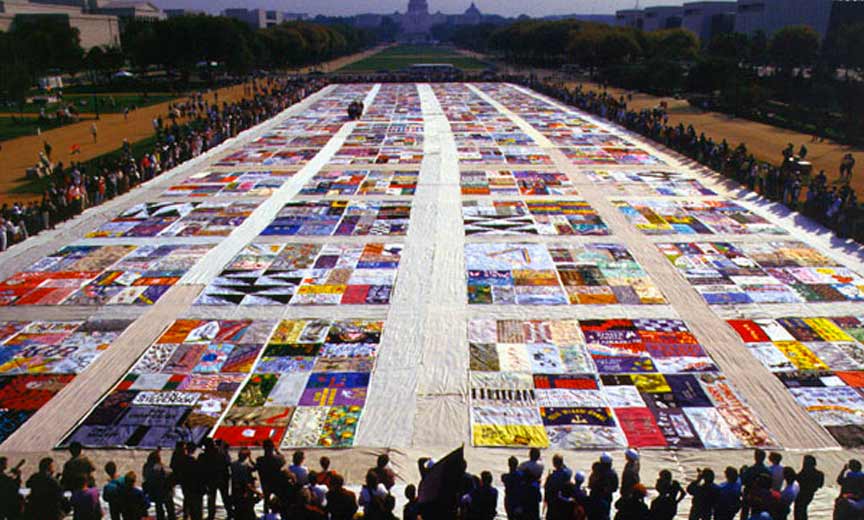


The NAMES Project is dedicated to showcasing the effects AIDS and HIV can have on the family of those who are HIV positive or who have lost members to the disease. They created The Quilt: a collaborative and ongoing project that memorializes those who have died from HIV and AIDS through quilted panels. These panels have the names of those who died and some symbolic imagery to represent them. According to its website, its goals are to "provide a creative means for remembrance and healing, effectively illustrate the enormity of the AIDS epidemic, increase the general public’s awareness of HIV and AIDS, assist others with HIV infection-prevention education, and raise funds for community-based AIDS service organizations." Since its founding in 1987, over 14 million people have visited The Quilt, and it has raised over $3 million in AIDS service organizations throughout North America. Even though it is far too large to display anymore, The Quilt is an amazing art piece that helps millions of people get through some of the hardest things to deal with.


GREAT job- and interesting choice
ReplyDelete